Find out who owns it, decide what it is worth to you, approach the owner (ideally without revealing who is buying), negotiate, and close through escrow. The steps above cover each part.
How to Buy a Domain That Is Already Taken
A taken domain is rarely a dead end. Here is how to find the owner, approach them, agree on a price and close the deal safely.
Start a confidential inquiry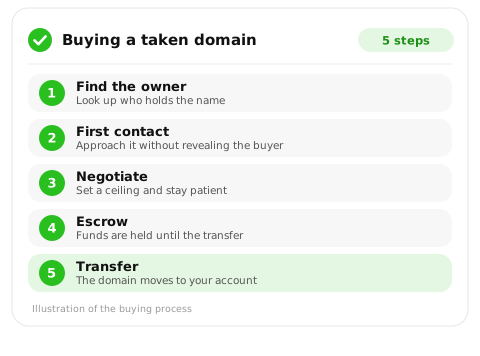
You found the perfect name, typed it in, and it's taken. Maybe it's parked, maybe it shows a website nobody has updated in years. You want to know whether you can actually buy it, what it will cost, and how not to get burned.
An unavailable domain name can often be bought from its current owner. Not always, and not at any price. This guide covers how it works in practice, and where buyers lose money or time.
Step 1: Decide what the name is worth to you
A domain has no list price. The price is whatever a seller and a buyer agree on, so the useful question is what the name is worth to your business. Set a budget before you contact anyone. Not a hope, a number your team agrees on.
If you are unsure what a realistic range looks like, get a domain appraisal first. No one can value a domain to an exact figure, but comparable sales and experience give you a range that keeps you from overpaying or from insulting the owner with a lowball.
Decide on your alternatives too. Knowing which other names you would accept changes how you negotiate. Buyers who believe only one name will work pay more, and sellers can tell.
Step 2: Find out who owns it
This is often the hardest part. Many owners hide their details behind a privacy service, so the public record shows a proxy, not a person. Ways people try:
- Look the domain up in a public registration lookup. You may see a name, a company or a privacy service.
- Check for a "this domain is for sale" banner or a broker's link.
- Look at the site's history and the company behind it, if there ever was one.
- Use the contact address or form on the site, if there is one.
- If there is a live website, check its legal notice or imprint page. Businesses in many European countries must publish one, with a company name and address.
Owners behind privacy services can usually still be reached, but it takes more work.
Step 3: Make the first contact
This is the step most buyers get wrong. When a well-funded startup or a known company emails the owner of the name it wants, the owner learns who you are and that you probably have money. Then the price changes. Not always, but often enough that it is the most common avoidable mistake we see.
You can write from a neutral email address with no company name. That works sometimes, but a determined seller can search the domain in your email or the details in your message. Or you can have a buyer's broker make the approach, so the seller never learns your name. See how to buy a domain anonymously.
Step 4: Pricing and negotiation
- Let the seller name the first price when you can. If you name a number first and the owner would have taken less, you lost money. If it's too low, you annoyed them. "What would it take?" is a better opening.
- Don't negotiate against yourself. If the seller doesn't respond, don't raise your offer. Silence is normal.
- Know your walk-away point and mean it. Set a ceiling at the start and stick to it. Sometimes the right answer is another name.
What does it cost? There is no standard price: a few hundred dollars for an unremarkable name, five or six figures for a short, clean .com, and sometimes seven or even eight figures for the very best names. Public sales are reported by DNJournal and NameBio, a useful reality check for what names like yours have sold for. Our domain price report collects DNJournal's top reported sales by extension, name length and year. It covers the top of the market, not typical prices.
Step 5: Escrow and transfer
Domain scams are common enough that this step is not optional. Never send money directly to someone you found by email, and never transfer a domain on trust.
Use an escrow service. The buyer pays the escrow company, the seller sees that the money is secured, the seller transfers the domain to your account, and only then is the money released. Neither side has to trust the other. Escrow.com is the default for most deals, and other services exist for other situations, for example crypto payments. In most deals the buyer pays the escrow fee.
Put the agreed terms in writing before anything moves: the exact domain, the price, who pays which fees, and how and by when the transfer happens. An escrow transaction records most of this for you. Then make sure:
- the domain goes to an account you control, registered in your company's name, not an employee's;
- the receiving registrar account is secured with two-factor authentication;
- whoever manages renewals in your company knows the name exists.
What if the owner doesn't reply?
Silence is normal, and it isn't a no. Emails land in spam, and some owners haven't checked that inbox in years. Don't raise your offer to get an answer. Follow up politely and try other channels: the contact form on the site, a "for sale" link, the forwarding address of a privacy service, or the address on a legal notice page.
When we run an acquisition, the first weeks are the intensive part, and we work every channel we can find. After that we keep following up at a slower pace, for up to a year or two if needed, because owners who ignore a first approach sometimes come back later. Sometimes a domain is not renewed and goes to an expired-domain auction, where it can be acquired.
Expect it to take time, and know your walk-away point. Here is a real example that has been shared publicly before, with no details of the people involved. We approached an owner for a client. He asked $35,000. The client's budget was around $20,000, so there was no deal. A few weeks later the owner's price was $50,000. A few months later, $100,000. About a year after our first contact, he agreed to $25,000, but by then our client had a different domain. We had bought them an alternative. The seller lost the sale, a year of renewal fees and some credibility. The buyer lost nothing, because in the end the buyer didn't need that one name. (Read the full story.)
Do it yourself, or hire a broker?
Do it yourself if the name is modest in value, you don't mind the owner learning who you are, and you have time. Bring in a buyer's broker if the name matters to your brand, if your company is the kind of buyer that makes sellers raise prices, if anonymity matters for internal or legal reasons, or if you don't want to spend weeks on cold outreach.
We have been negotiating acquisitions like these since 2010. Our domain acquisition service is built for this, and if you are still choosing, read How to Choose a Domain Broker.
What a broker costs
There is no upfront fee, and every acquisition starts with a complimentary, confidential consultation. You pay only if the domain is acquired, and you choose the model before we start:
- Savings-based: 5% of the final price plus 15% of the savings we negotiate (the owner's first asking price minus the final price).
- Flat: 10% of the final price.
The fee is added to the same escrow transaction, so you make one payment. Our fee is success-based: if we can't acquire the domain, you pay no fee.
Frequently asked questions about buying a taken domain
- Often, yes. Registered only means someone owns it. A parked or for-sale domain is usually easier. A domain running an active business is a harder negotiation and costs more. Nobody can guarantee a purchase, because the owner decides whether to sell.
- If you contact them yourself, assume they may find out. When we handle the acquisition, the owner negotiates with us and we don't reveal our client. Unless both sides agree otherwise, the escrow transaction is also set up so the seller does not see who the buyer is.
- Silence is normal, and it isn't a no. Don't raise your offer. Follow up politely and try other channels. We work intensively in the first weeks, then keep following up at a slower pace for up to a year or two. Sometimes the domain is not renewed and goes to an expired-domain auction.
- It depends mostly on the owner. Some deals close within days of first contact, others take many months. Start early, before a launch date or a rebrand turns the name into a deadline.
- Some owners will not sell at any price, and no approach changes that. A first refusal isn't always final, though, and a price that is too high today may come down later. Sometimes it doesn't, and the right answer is another name. Our fee is success-based: if we can't acquire the domain, you pay no fee, and we can help you look at alternatives.
- Two things: the price you agree with the owner, and, if you work with us, our fee. There is no upfront fee. If we acquire the domain, you pay either 5% of the final price plus 15% of the savings we negotiate, or a flat 10% of the final price. The fee is added to the same escrow transaction, so you make one payment. The escrow fee is paid by the buyer unless agreed otherwise.
- Not without protection. Use an escrow service such as Escrow.com, so the money is released to the seller only after the domain is in your account.
Thinking about a name that is already taken?
Tell us the name you want, or the kind of name you need, and a rough budget. We'll tell you what is realistic, approach the owner without revealing who you are, and run the deal through escrow.
Start a confidential inquiry